Warning: include(/home/jqowuojq/api.ambreyolifesciences.com/wp-content/advanced-cache.php): Failed to open stream: Permission denied in /home/jqowuojq/api.ambreyolifesciences.com/wp-settings.php on line 100

Warning: include(): Failed opening '/home/jqowuojq/api.ambreyolifesciences.com/wp-content/advanced-cache.php' for inclusion (include_path='.:/opt/alt/php83/usr/share/pear:/opt/alt/php83/usr/share/php:/usr/share/pear:/usr/share/php') in /home/jqowuojq/api.ambreyolifesciences.com/wp-settings.php on line 100
Pharma Business Guide Archives - Ambreyo Lifesciences

Category: Pharma Business Guide

  • PCD Pharma Franchise in India: A Complete Guide for New Entrepreneurs

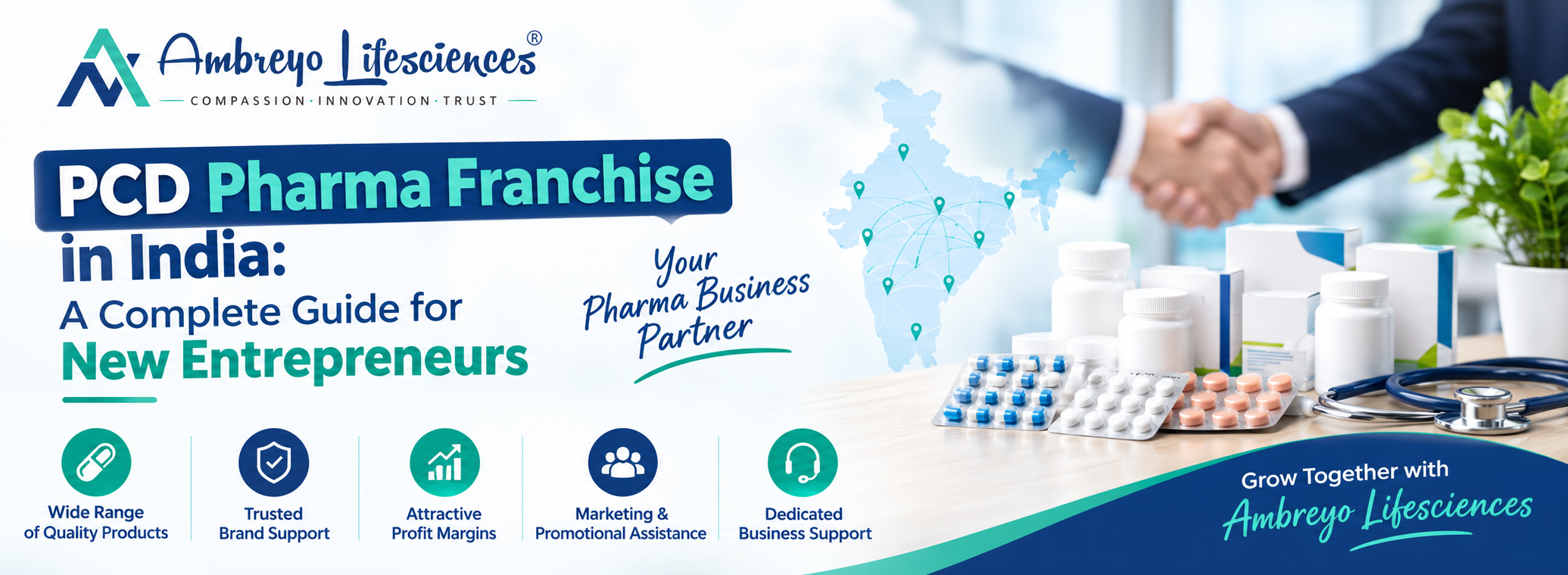
    PCD Pharma Franchise in India: A Complete Guide for New Entrepreneurs

    India is one of the world’s largest producers of medicines by volume, and healthcare demand keeps rising across cities, towns and villages. For a new entrepreneur, a PCD pharma franchise in India is one of the most accessible ways into this industry. It needs no factory, no large team and no heavy capital. What it does need is the right knowledge, the right licenses and a clear plan for your territory.

    This guide explains how the model works, what it costs, what the law requires and how to avoid common mistakes. It also covers what comes next once your business grows, including third-party manufacturing.

    What Is a PCD Pharma Franchise?

    PCD stands for Propaganda-cum-Distribution. In this model, a pharmaceutical company grants you the right to promote and distribute its products in a defined area, such as a district, a state or a cluster of districts.

    • The pharma company handles manufacturing, quality control, regulatory approvals and product development.
    • The franchise partner handles promotion, sales and distribution in the territory.

    You run your own business using an established company’s products and supply chain.

    How Does the PCD Model Work?

    1. You sign an agreement with a pharma company for a specific territory.
    2. You place orders, and the company supplies the products with proper invoicing.
    3. You promote the products to doctors, clinics, hospitals, chemists and stockists.
    4. Orders convert into sales, and you earn a margin, which is the difference between your purchase price and selling price.
    5. You repeat the cycle, add products and expand your reach over time.

    Many companies offer monopoly rights, which means only one partner sells their products in a given area. This protects the partner’s market and effort.

    Why Do Entrepreneurs Choose PCD Pharma?

    • Low entry barrier: Startup costs are much lower than for manufacturing or a large wholesale business.
    • Need-based demand: Healthcare is a necessity, so the market is stable compared with many other sectors.
    • Scalable model: You can begin small and add products, divisions and territories.
    • Company support: Many companies offer product training, promotional material and regulatory documentation.
    • Business independence: You build your own network and control your own operations.

    What Investment Does It Need?

    Investment varies with the company, territory and scale, and you’ll find very different figures online. Plan for these cost heads:

    • Drug license and registration fees
    • Minimum initial order, where the company sets one
    • Office or storage space
    • Promotional tools and samples
    • Field travel and marketing expenses
    • Working capital for the first few months

    Ask for a written breakdown of costs, and be careful with any offer that demands a large non-refundable fee without a proper agreement.

    Legal Requirements to Start

    Rules differ by state and business type, so always confirm current requirements with your State Drug Control authority or a qualified consultant. In general, you will need:

    • Drug License: A wholesale license requires suitable premises with proper storage and a competent person as defined in the Drugs and Cosmetics Rules. A retail license requires a registered pharmacist.
    • GST Registration: For invoicing and tax compliance.
    • PAN and Business Registration: As a proprietorship, partnership or company.
    • Current Bank Account: In the business name.
    • Franchise Agreement: A written agreement covering territory, products, duration, exclusivity and termination terms.

    You should also understand the Uniform Code for Pharmaceutical Marketing Practices (UCPMP), which sets ethical standards for promoting medicines and dealing with healthcare professionals.

    How to Choose the Right PCD Pharma Company

    Your partner company strongly influences your success. Evaluate them on these points:

    1. Manufacturing and quality: Check that products are made at a facility with valid licenses and GMP-compliant practices. Ask for documents and verify them.
    2. Product range: A broad range across therapeutic segments (general medicine, antibiotics, gastro, cardio-diabetic, pain management, dermatology, nutraceuticals and Ayurvedic products) gives you more to offer doctors and chemists.
    3. Territory and exclusivity: Get your territory and monopoly rights in writing.
    4. Pricing and margins: Compare against market rates. Unusually high margins on poor-quality products are a warning sign.
    5. Marketing support: Look for visual aids, literature, samples and training.
    6. Supply reliability: Delays in delivery damage your credibility with customers. Ask about dispatch timelines and stock availability.
    7. Transparency: Verify the company’s address, licenses, website and track record. Speak to existing partners if you can.

    Step-by-Step: Starting Your PCD Pharma Business

    1. Research your market. Study the doctor base, chemist density and competition in your target area.
    2. Pick a segment. Choose between general, specialty or Ayurvedic products, depending on local demand.
    3. Shortlist companies. Compare three to five on quality, range, support and terms.
    4. Get licensed. Apply for your drug license and GST registration.
    5. Sign a clear agreement. Read every clause on territory, minimum orders and exit terms.
    6. Start with a focused first order. Choose fast-moving products and avoid overstocking.
    7. Build relationships. Visit doctors, chemists and stockists regularly.
    8. Review and expand. Track what sells, then add products or areas gradually.

    PCD Franchise vs. Third-Party Manufacturing

    As your business matures, you may want your own brand instead of selling someone else’s. That is where third-party (contract) manufacturing comes in. Here you market products under your own brand name, while an established manufacturer produces them to your specifications.

    PCD Pharma Franchise Third-Party Manufacturing
    Brand The company’s brand Your own brand
    Investment Lower Higher (batch quantities, packaging, brand registration)
    Control Sales and distribution only Range, packaging and pricing
    Best for First-time entrepreneurs Established marketers and distributors
    Long-term value Network and market knowledge Brand equity

    Many entrepreneurs start with PCD to learn the market, then move to third-party manufacturing once demand is proven and they are ready to build their own brand. Manufacturing partners in India serve both Allopathic and Ayurvedic categories, so you can choose based on your market and expertise.

    Common Mistakes to Avoid

    • Choosing a company only for the lowest price or highest margin
    • Skipping license verification and paperwork
    • Working without a written agreement on territory and exclusivity
    • Overstocking before understanding local demand
    • Ignoring compliance and ethical marketing rules
    • Expecting fast profits without steady field effort

    Challenges to Prepare For

    Expect competition, slow early sales and the time it takes for doctors to trust a new brand. Credit cycles with chemists can also strain working capital. Consistent effort, product knowledge and reliable service are what separate successful partners from the rest.
  • 12 Questions to Ask Before Choosing a PCD Pharma Company

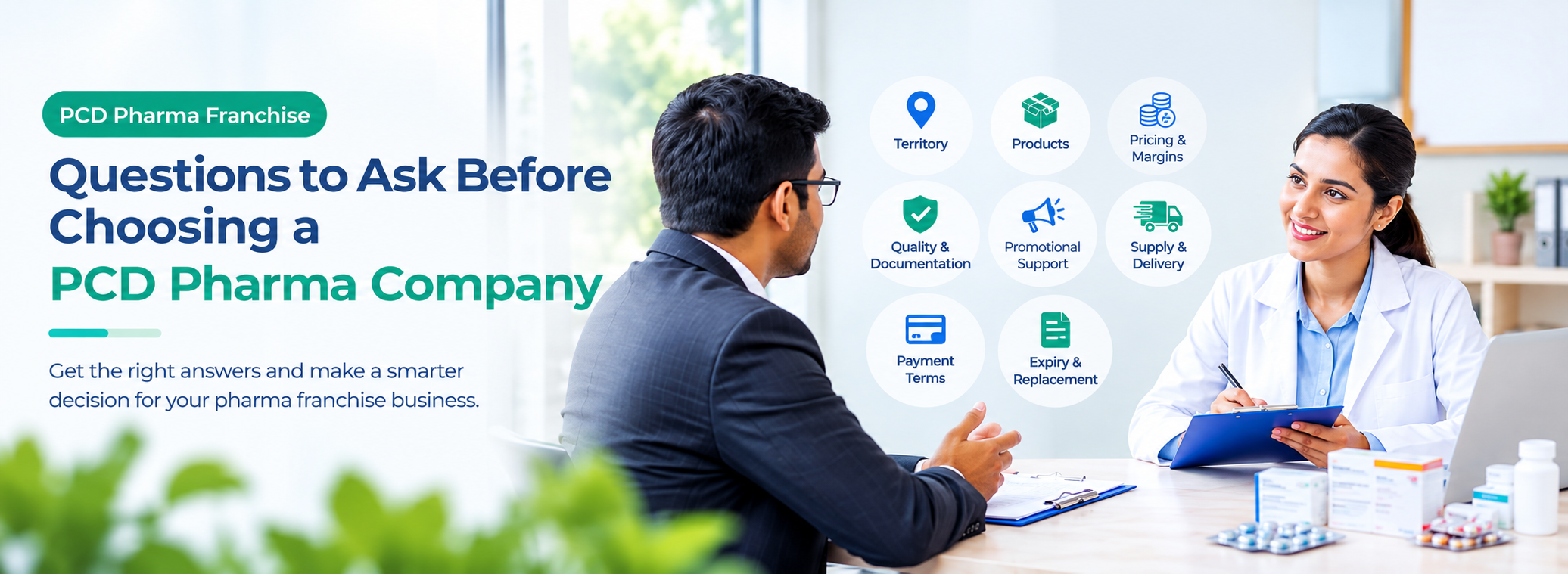
    12 Questions to Ask Before Choosing a PCD Pharma Company

    Here’s something nobody tells you when you start looking at PCD pharma franchise opportunities: finding a company is easy. Finding the right one is where most people slip up.

    Open Google or IndiaMART and you’ll see hundreds of offers. Every one promises “high margins”, “monopoly rights” and “zero investment”. They all sound great. A few months later, some distributors are stuck with stock that won’t sell, a company that has stopped answering calls, or a product that gets pulled up in a quality check.

    So before you pay a security deposit or place your first order, sit down with the company and ask the questions below. If a company gets uncomfortable, or answers with fluff, that tells you plenty.

    1. Does the company have its own manufacturing unit, or is it just a marketer?

    Some PCD companies manufacture in their own plant. Others buy from third-party units and only handle sales. Neither is automatically bad, but you need to know which one you’re dealing with.

    Ask directly: Who makes the product I’ll be selling? If it’s third-party manufactured, ask for the manufacturer’s name and licence number. If something goes wrong with a batch, you want to know exactly who is responsible.

    2. Are the licences genuine and up to date?

    This one is non-negotiable. Ask to see:

    • The manufacturing licence issued by the State Drug Control authority
    • The GST registration
    • WHO-GMP or other quality certificates, if they claim to have them
    • Product permissions and approvals for the specific formulations you’ll sell (for example, FSSAI for nutraceuticals or the relevant AYUSH licence for ayurvedic products)

    Don’t just accept a PDF on WhatsApp. Check the licence number, the validity date and whether the address matches the factory they’ve described. It takes ten minutes and can save you months of trouble.

    3. Is the facility compliant with the revised Schedule M?

    This is a newer question, and a very important one. The revised Schedule M (India’s updated Good Manufacturing Practices rules) has been in force for all manufacturing units since 1 January 2026, after the last extension for smaller units ran out at the end of 2025. State drug regulators are inspecting units, and the ones that haven’t upgraded risk action.

    Ask the company plainly: Is your plant compliant with revised Schedule M, and can you show me the proof? A company that has done the upgrade will be happy to talk about it. One that changes the subject is a red flag, because a plant that can’t keep its licence can’t keep your supply going either.

    4. What does the product range look like, and does it fit your market?

    A long catalogue isn’t the same as a useful one. Think about the doctors, chemists and hospitals in your territory. Do they prescribe what this company sells?

    A good PCD company should offer a balanced range, for example general tablets and capsules, injections, syrups, softgels, and, if you want it, ayurvedic or nutraceutical products. More important than size, though, is whether the specific products suit the diseases and prescribing habits in your area.

    Ask which products are their fast movers and why. A confident company will have real answers.

    5. Will you get exclusive territory rights?

    “Monopoly rights” is the most overused phrase in this industry, so don’t take it at face value. Ask:

    • Is the exclusivity for the whole product range, or only for selected products?
    • Is it for a district, a state, or just a few towns?
    • Will you get it in writing, with the area clearly named?
    • What happens if you miss a sales target? Can they give your area to someone else?

    If the answers are vague, assume the protection is weaker than advertised.

    6. What are the real numbers: MOQ, pricing and margins?

    Don’t stop at the headline margin. Ask for a full price list and work out the numbers yourself.

    • What’s the minimum order quantity for the first order, and for repeat orders?
    • Is the quoted price (PTR/PTS) inclusive or exclusive of GST?
    • What are the freight and packing charges?
    • What are the payment terms: advance, partial or credit?
    • Are there any hidden fees, such as registration, security deposit or “branding” charges?

    A 30% margin on a product doctors never prescribe is worth less than a 20% margin on one that moves every week.

    7. How do they handle quality, and can you see the proof?

    When a patient has a bad experience, it’s your name the chemist and doctor remember, not the manufacturer’s. So ask about quality before you commit.

    • Can they share batch-wise Certificates of Analysis (COA)?
    • Do they test raw materials and finished products in-house or at an approved lab?
    • Has the company or the manufacturing unit had products declared “Not of Standard Quality” (NSQ) in the past? You can often find this in public regulator reports.
    • What is the shelf life on delivery? Ask for stock with a reasonable remaining life.

    A company that takes quality seriously won’t mind these questions.

    8. What marketing and promotional support will you actually get?

    Medicines don’t sell themselves. A doctor needs a reason to try a new brand from a company they haven’t heard of.

    Find out what’s included: visual aids, product literature, detailing material, doctor’s samples, brand reminders and training for your team. Also ask whether the company follows ethical marketing norms and doesn’t push you to promote in ways that could land you in trouble.

    Good support isn’t about freebies. It’s about helping you build trust with prescribers.

    9. What’s the policy on expiry, returns and slow-moving stock?

    This is the question distributors forget until it hurts. Every distributor ends up with some slow stock. What matters is what the company does about it.

    Ask:

    • Will they accept near-expiry or non-moving stock for replacement or credit?
    • Is there a time limit or a percentage limit on returns?
    • Who pays the freight on returns?

    Get the answer in writing. A verbal “we’ll manage it” is not a policy.

    10. How quickly do they deliver, and how reliable is the supply?

    Running out of a product your doctor has just started prescribing is how you lose that doctor. So ask about:

    • Standard dispatch time after an order is confirmed
    • How they handle backorders and shortages
    • Which transport partners they use
    • Whether packaging is properly done for tablets, injections and liquids

    If you can, check this from an existing distributor’s experience rather than relying on the company’s word.

    11. Can you talk to their existing distributors?

    This is the best due diligence you can do, and it costs nothing. Ask the company for references from two or three active distributors, preferably in states other than yours so there’s no conflict.

    Then call them and ask: Is the company honest on pricing? Do they dispatch on time? How do they handle complaints? Would you sign with them again?

    Pay as much attention to what people don’t say as to what they do. A pause before answering usually means something.

    12. What does the agreement actually say?

    Never start a business relationship on a handshake. Before you sign, read the agreement carefully and look out for:

    • The exact territory and products covered
    • Duration, renewal and termination terms
    • Minimum sales commitments (and the penalty for missing them)
    • Who owns the brand names and trademarks
    • Dispute resolution and the jurisdiction (which city’s courts apply)

    If you’re not comfortable with legal language, it’s worth paying a lawyer a small fee to read it. That’s cheap compared with what a bad contract can cost.

    A few things you’ll need on your side

    A good company will also ask you some questions. To run a PCD pharma franchise in India, you’ll typically need a valid drug licence (wholesale), a GST number, and a basic setup for storage and distribution. Requirements can vary by state, so it’s worth checking with your local drug control office before you place your first order.

    Quick red flags to watch for

    • They refuse to show licences or certificates
    • They push you to pay a large amount up front, with nothing in writing
    • The margins on offer are far higher than anyone else’s
    • They’re slow to answer questions now (it only gets worse after you’ve paid)
    • They have no references, or won’t share any

    The bottom line

    Choosing a PCD pharma company is really a long-term partnership, not a one-time purchase. The right partner gives you good products, honest pricing, steady supply and genuine support, and in return, you put in the work of building relationships in your territory.

    Take your time, ask the awkward questions, and get everything important in writing. A few extra days of checking now can save you a lot of money and stress later.


    Looking for a PCD pharma partner you can ask these questions to?

    At Ambreyo Lifesciences, we’re happy to answer every one of them, with documents. Our range covers general tablets and capsules, injections, softgels, syrups and ayurvedic products. Whether you’re starting out or expanding your existing business, we’d love to talk.

    📞 Call or WhatsApp: +91-9736308080
    ✉️ Email: enquire@ambreyolifesciences.com